Our Products
Back > Dragon Maharaj
We Provide
Top-Quality Seeds for Your Farm
Seed Name
- NAGINI (F1-HYBRID BITTERGOURD)
- DRAGON MAHARAJ(F1-HYBRID WATERMELON)
- NAYAK (F1-HYBRID BOTTLEGOURD)
- KUNDAN (F1-HYBRID BOTTLEGOURD)
- BLUE 15 (F1-HYBRID PAPAYA)
- RED QUEEN 369 (F1-HYBRID PAPAYA))
- GAJENDRA (F1-HYBRID TOMATO)
- ICE KING (F1-HYBRID WATERMELON))
- MAHANATI (F1-HYBRID BITTERGOURD)
- BHUSHAAN (F1-HYBRID BITTERGOURD)
- 641 (F1- HYBRID CHILLI)
- 955 (F1- HYBRID CHILLI)
- MahishmatI 1988(F1- HYBRID CHILLI)
- ALMORA (F1-HYBRID CHILLI)
- BLUE GOLD(F1-HYBRID CHILLI)
- 2244 (F1-HYBRID CHILLI)
- 22 PLUS (F1-HYBRID CHILLI)
- BOLD ORANGE (F1-HYBRID CHILLI)
- ASTAGAMI (F1-HYBRID CHILLI)
- YELLOW BALL (F1-HYBRID CHILLI)
- VARSHINI 22 (F1-HYBRID CHILLI)
Explore more seeds here 👉
DRAGON MAHARAJ (F1 HYBRID WATERMELON)
Description
DRAGON MAHARAJ
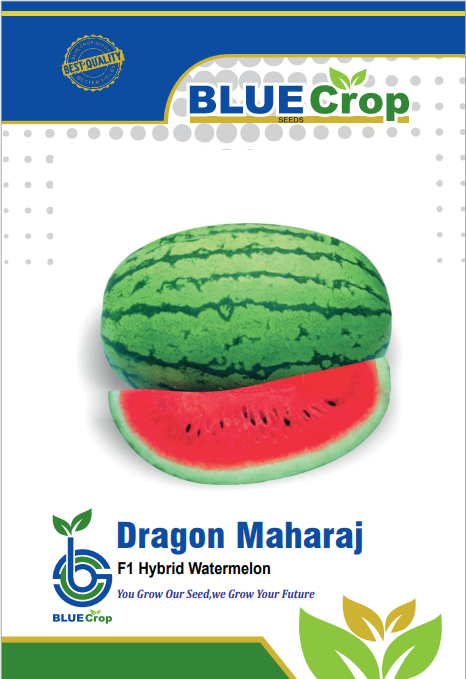
WATERMELON (Dragon Maharaj) is a prolific variety with sweet and crisp flesh, designed for long-distance transportability.
Features
- Sweetness: TSS 10% to 11%
- Prolific fruit set and good yield
- Durable rind: Ideal for long-distance transportability
- Maturity: 85 to 90 days
- Color: Light green with dark green strips, bright red crisp flesh
Characteristics
- Yield: Average 18 MT/acre (depending on season and cultural practice)
- Shape: Oblong fruit shape
- Plant Type: Asian Jubili Type Watermelon
- Weight: 8–12 kg
Recommended States
| Season | States |
| Kharif | KA, TN, AP, TS |
| Rabi | AP, TS, BR, CG, GJ, HP, PB, KA, MP, OD, RJ, TN, UP, WB, AS, TR |
| Summer | KA, RJ, TN |
Agronomy
Sowing / Plantation Season
- Season: July to October
Plant Population
- Density: 7,000–7,500 plants per acre
Seed Rate
- Quantity: 400–500 gm per acre
Suitability of the Variety for the Area
- Agro-Climatic Zone: All India
Field Preparation Practices
- Land Selection:
- Medium soil, loam to sandy loam with excellent drainage.
- Prefer land without a history of Cucurbitaceae crops.
- Preparation:
- 1–2 deep ploughing followed by 3–4 rounds of harrowing for fine tilth.
- Apply 8–10 MT well-decomposed FYM/acre and 1 kg Trichoderma before final harrow to control soil-borne fungus.
Seed Treatment
- Chemical and Rate: Treat seeds with Carbendazim 2g + Thiram 2g per kg of seeds.
Sowing Details
| Aspect | Details |
| Timing | Late Winter, Early Summer, Summer |
| Method | Line sowing or direct sowing |
| Seed Rate | 300–350 g per acre |
| Spacing | 120 × 30 cm (Single Row) or 240 × 30 cm (Double Row) |
Fertilizer Dose with Timing
| Dose Type | Application Timing | N:P:K Requirement |
| Basal | During final land preparation | 50% N and 100% P, K |
| Top Dressing | 30 and 50 days after sowing | 25% N each time |
Weed Control
- Perform timely hand weeding before fruit set for a healthy crop.
Diseases and Pest Control
- Major Pests: Leaf miners, thrips, fruit flies
- Major Diseases: Downy mildew, powdery mildew, wilt, anthracnose, gummy stem blight
- Apply fungicides and insecticides as recommended by the Department of Agriculture.
- Avoid spraying insecticides during flowering (30–50 days) to enable honeybee pollination.
Irrigation Schedule
- Regular irrigation is required to prevent fruit cracking.
- Increase frequency in light soil and during the summer season.
Harvesting
- Maturity: 85–90 days after sowing
- Indicators:
- Dead tendril attached to the vine
- Dull appearance compared to a slick appearance
- Metallic sound when tapped
Post-Harvest Care:
Do not leave harvested fruits in the sun to prevent sun scalding.
Product Image